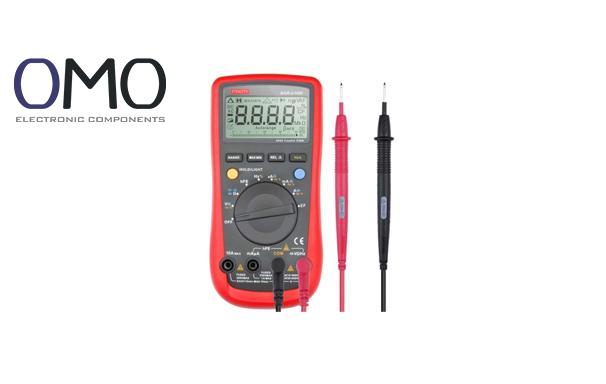
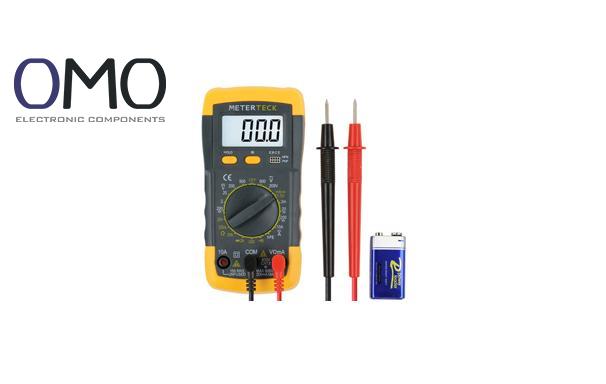
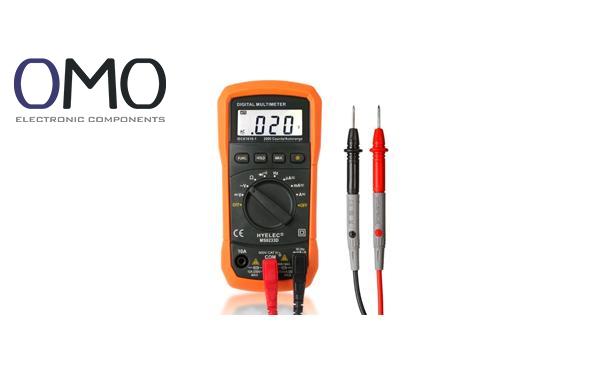
The main task of a multimeter is to measure basic electrical parameters:
DC Voltage (DC V)
AC Voltage (AC V)
DC Current (DC A)
AC Current (AC A)
Resistance (Ω)
High-end models can also measure capacitance (F), frequency (Hz), diode voltage drop, and continuity with buzzer. These features support complex situations. Accurate data is the base for troubleshooting and design verification.
Core Components
Understanding the structure is the key to safe operation:
Dial/Display: Shows the value by pointer (analog meter) or digits (digital meter).
Range Selector Knob: Lets you choose the parameter (V, A, Ω) and the proper range.
Test Lead Ports: Usually marked as:
COM (common ground, black probe)
VΩ (voltage/resistance/continuity, red probe)
mA/A (current measurement, red probe). Large current often needs a special port.
Internal Circuit: Includes precision resistor network, Analog-to-Digital Converter (ADC), operational amplifiers, etc. They process and convert the signal.
Features
Modern Digital Multimeters (DMM) usually have:
High accuracy and resolution: About 0.5% DC accuracy, display up to 4.5 digits (19999) or more.
High input impedance: Normally ≥10MΩ (voltage mode), reduces effect on the tested circuit.
Auto Range: Automatically selects the best measurement range.
Useful functions: Data hold, relative value, max/min record.
Principle of DC Voltage Measurement
When measuring DC voltage, the precision resistor network (divider) reduces the voltage to a safe level for the ADC. The ADC converts the signal into digital numbers for display. The high input impedance avoids current diversion and prevents low readings.
Principle of AC Voltage Measurement
Measuring AC voltage is more complex. The AC signal first goes through a rectifier to become pulsed DC. Then the average value is calculated. The meter algorithm converts this to the RMS (Root Mean Square) value for a sine wave. A True RMS meter can measure non-sine waves (square, sawtooth) correctly.
Voltage Units and Ranges
The unit of voltage is Volt (V). For high voltage we use kilovolt (kV), for small voltage millivolt (mV). Multimeter ranges must cover the expected value. Common manual ranges: 200mV, 2V, 20V, 200V, 600V/1000V. If the value is higher, the screen shows “OL” (overload).
Limits: Reading error (parallax), low input impedance, overload may damage the pointer, no auto range or data hold.
Advantage: Good for quick signal changes (e.g., tuning signal generator). But less accurate and safe than digital type.
Digital Multimeter (Functions and Advantages)
It converts analog signals into digital values (LCD/LED).
Functions: High accuracy, high resolution, high input impedance. It has auto range, data hold, buzzer, diode test, capacitance, frequency counter, and overload protection.
Advantages: Clear reading, no error, strong anti-interference, high safety.
Comparison: The main choice today, much better than analog in precision and recording.
Clamp Multimeter (Functions and Special Use)
It has a built-in current transformer or Hall sensor. It measures AC/DC current without contact (clamp opening).
Functions: Main for large current measurement without breaking the circuit.
Applications: Power line load check, industrial current monitoring, leakage detection, motor start current.
Advantage: Very safe and easy for large current in fixed lines. Essential for electricians.
Auto Range vs Manual Range Multimeter
Auto Range: Detects signal size and sets the best range. Easy to use, best for beginners. But may delay slightly when switching.
Manual Range: User sets the range. Faster, avoids wrong switching due to noise. Best for experienced users and special signals.
Voltage Symbols on Multimeter
DC Voltage (DC V) Symbol
Common symbols: V, V⎓, VDC, -V, straight line ⎓ or solid line + dashed line. Usually with COM and VΩ ports.
Key: Look for the opposite of wave line (~), often with “-”.
AC Voltage (AC V) Symbol
Common symbols: V~, AC V, VAC, V, sine wave (). Also use COM and VΩ ports.
Key: Look for wave line (~) or “AC”.
Multi-Range Voltage (mV, kV)
mV: For small voltage (e.g., 200mV). Symbol mV.
kV: For high voltage (e.g., 600V+). Symbol kV. Use high-voltage probe and check CAT rating.
Tip: Read the knob scale carefully. mV is in the small ranges.
Match Symbol and Mode
Risk: If using DC mode to measure AC (or opposite), the result is wrong or unreadable. Always check knob direction (V⎓ or V~).
Range: If unknown, use the highest first, then lower.
Safety: For mains (~220V), use correct port (COM, VΩ), correct AC range (600V), and wear protection.
Testing Methods and Steps
Preparation (Safety and Setup)
Safety first: Power off before test (except voltage). Keep dry.
Check meter: Probes, battery, screen, fuse. Use safe probes.
Ports and range: Red to VΩ, black to COM. Turn knob to right function and range.
Mode check: Choose AC/DC correctly.
Voltage Test (DC and AC)
Select points: Example: battery + and -.
Parallel connection: Black to ground/-, red to test point.
Read value: The display shows voltage. “1” or “OL” = out of range.
True RMS: Needed for non-sine AC.
High voltage caution: Hold probes with one hand, use CAT-rated meter, avoid body loop.
Current Test (DC and AC)
Series method (probes):
Power off circuit.
Move red probe to mA/A port, black to COM. Select DC A or AC A.
Connect in series: black to source -, red to load.
Power on, read current. Large current may blow fuse.
Clamp method (clamp meter only):
Open clamp, put around one wire.
Close clamp, select AC/DC current.
Read directly.
Resistance Test (Continuity)
Power off and discharge. Capacitors must discharge.
Isolate one end from circuit.
Red to VΩ, black to COM, knob to Ω.
Zero adjustment (for analog).
Touch both ends, read resistance.
Continuity test: Use buzzer mode. If <30–50Ω, buzzer sounds (good connection).
After Test (Maintenance)
Remove probes/clamp.
Set knob to safe range or OFF.
Clean and store dry.
Calibrate regularly (e.g., yearly).
Replace battery and fuse with correct type.
Common Uses of Multimeter
Electronic repair: Find short/open circuits, test parts (resistor, capacitor, diode, transistor), check power supply.
The International Electrotechnical Commission (IEC) recommends V⎓ and V- as graphical symbols for DC voltage. These complement the standard representation featuring a solid line (―) positioned above three shorter dashes. The solid horizontal line specifically denotes the unidirectional nature of direct current flow.
What is the DC voltage?
Direct current (DC) voltage denotes an electrical potential difference with unvarying polarity. This results in current traveling continuously in a single direction. Typical sources include batteries, photovoltaic cells, and DC power supply units.
How to use DC symbol on multimeter?
Set the multimeter to DC voltage (usually labeled V⎓ or V DC). Choose a suitable measurement range (like 2V or 20V) matching the expected voltage level. Attach the red probe to the DC source's positive (+) terminal and the black probe to its negative (-) terminal.
What are the three symbols for voltage?
Voltage is typically represented by three key symbols: Vfor general voltage, V⎓specifically indicating direct current (DC) voltage (characterized by unidirectional flow), and V~denoting alternating current (AC) voltage (marked by periodic reversal).