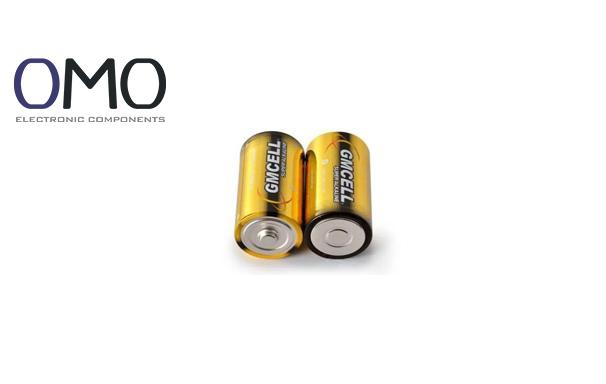
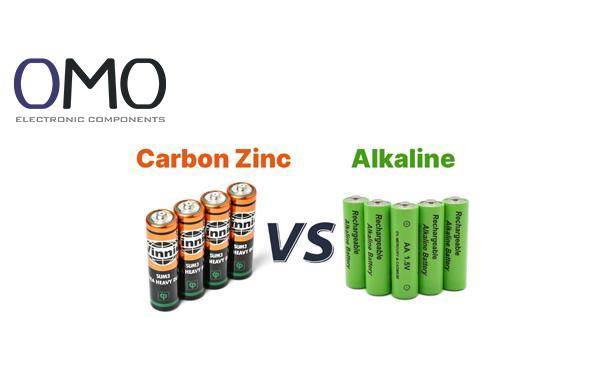
Alkaline batteries (Alkaline Batteries) are widely used disposable dry cells. They are known for high energy density and stable lifetime. With advanced chemical design and multi-layer structure, they give strong energy output. They are very good for medium and high power devices. The main parts include:
Anode material: powdered zinc (Zn). It gives electrons and keeps reaction efficient.
Cathode material: manganese dioxide (MnO₂). It works in redox reaction and stores energy.
Electrolyte: alkaline potassium hydroxide (KOH). It helps ion transfer and improves conductivity.
Separator: porous non-woven fabric. It keeps electrodes apart and prevents short circuit.
Casing: steel or nickel shell. It gives sealing and strong body.
The structure has a precise layered design. Inside, zinc anode layers, separator layers, and manganese dioxide cathode layers are stacked. A carbon rod in the center collects current and helps conduction. On the top, a pressure valve prevents leakage. At the bottom, an insulation ring gives safety.
Main advantages: nominal voltage is stable at 1.5V, discharge curve is smooth, and it works well for long high-load use.
Electrolyte KOH helps OH⁻ ion move to complete the circuit.
Main features:
High capacity (2000–3000mAh, long power supply).
Low self-discharge (2%-3% per year, storage 5–10 years).
Wide temperature use (-20°C to 70°C).
No mercury design, easy to recycle (needs special treatment).
Medium to high cost (better long life than carbon-zinc).
Data visualization:
Imagine a bar chart. X-axis = years (1–5). Y-axis = remaining capacity (%).
Alkaline line: slow drop from 100% to 90%.
Carbon-zinc line: fast drop to 50%.
This shows alkaline batteries store longer with low self-discharge.
What is a Carbon-Zinc Battery?
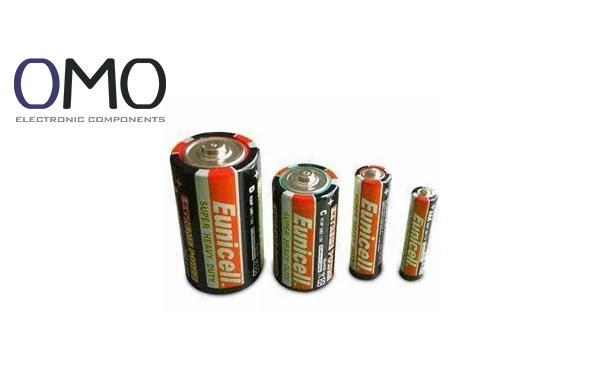
Carbon-zinc batteries (Carbon-Zinc Batteries) are low-cost disposable dry cells. They save money but lose performance. They are good for low-power, short-time use. Their cost is only 30%–50% of alkaline. The main parts include:
Anode material: zinc can (Zn). It is the shell and electron source, but it corrodes.
Cathode material: manganese dioxide (MnO₂) mixed with carbon powder. It improves conduction.
Electrolyte: acidic or salt-based liquid (ZnCl₂ or NH₄Cl). It helps H⁺ ion transfer.
Separator: paper or fiber. It prevents short circuit but not strong.
Casing: zinc shell. It is simple but weak.
The design is very simple. The zinc shell holds electrolyte and cathode mix. A carbon rod in the center works as current collector. There are no strong separators. This cheap design is easy to make but has higher leakage risk.
Working principle:
At anode: zinc oxidizes (Zn → Zn²⁺ + 2e⁻).
At cathode: reduction (2MnO₂ + 2H⁺ + 2e⁻ → 2MnOOH).
Acidic electrolyte makes discharge unstable (nominal 1.5V but drops fast).
Main features:
Low capacity (500–1000mAh, short life).
High self-discharge (10% per year, storage only 2–3 years).
Narrow temperature range (0°C–40°C, poor outside this).
High leakage risk (zinc corrodes in wet air).
Low recycling, pollution risk.
Data visualization:
Imagine a temperature curve. X-axis = -20°C to 70°C. Y-axis = efficiency (%).
Carbon-zinc line: drops to 10% below 0°C or above 40°C.
Alkaline line: stays above 85%.
This shows carbon-zinc batteries work in narrow conditions.
Main Differences Between Alkaline and Carbon-Zinc Batteries
Key differences:
Voltage stability: alkaline keeps 1.5V stable; carbon-zinc drops quickly.
Capacity and life: alkaline (2000–3000mAh, 5–10 years storage); carbon-zinc (500–1000mAh, 2–3 years).
Cost and design: carbon-zinc is cheaper and simple; alkaline is complex and costs more but lasts longer.
Environment use: alkaline works from -20°C to 70°C; carbon-zinc only 0°C to 40°C.
Other: alkaline <3% self-discharge per year; carbon-zinc >10%. Alkaline is heavier, carbon-zinc is lighter.
Comparison
Feature
Alkaline
Carbon-Zinc
Typical Capacity
2500mAh
750mAh
Self-discharge (year)
≤3%
≥10%
Working Temp.
-20°C to 70°C
0°C to 40°C
Leakage Risk
Low
High
Storage Life
5–10 years
2–3 years
Uses of Alkaline and Carbon-Zinc Batteries
Alkaline battery uses:
High power devices: remote toys, cameras, flashlights, game controllers.
Long-time low power devices: clocks, remotes, torches.
Carbon-zinc battery uses:
Low power devices: simple remotes, wall clocks, calculators, small toys.
One-time uses: gifts, festival lights, short events.
Budget use: education kits, cheap electronics.
Example Uses
Device Type
Recommended Battery
Reason
Digital camera (high power)
Alkaline
High capacity and stable voltage
Wall clock (low power)
Carbon-zinc
Low cost
Smoke alarm (critical tool)
Alkaline
Long storage and reliable
Festival lights (one-time)
Carbon-zinc
Cheap and practical
Advantages and Disadvantages
Alkaline advantages:
High energy density (50%–100% more).
Long life (low self-discharge, storage >5 years).
Stable output (good for high power).
Wide temperature use (-20°C to 70°C).
Mercury-free, easier to recycle.
Alkaline disadvantages:
Higher cost.
Heavier weight.
Recycling needs special process.
Carbon-zinc advantages:
Very low cost (30%–50% of alkaline).
Light and simple.
Ready to use.
Carbon-zinc disadvantages:
Low capacity and short life.
High leakage risk.
Unstable voltage and temperature sensitive.
Performance Values
Feature
Alkaline Value
Carbon-Zinc Value
Self-discharge (year)
≤3%
≥10%
Working Temp.
Wide, 90% efficiency
Narrow, 40% efficiency
Leakage Rate
<1%
>5%
Can Alkaline and Carbon-Zinc Batteries Replace Each Other?
Possible replacement:
Low power devices (clocks, simple remotes). Both give 1.5V and same size (AA/AAA).
Emergency backup: carbon-zinc can replace alkaline but lasts shorter.
Same size fit: physical size is usually compatible.
Not suitable replacement:
High power devices (cameras, flashlights). Carbon-zinc cannot give stable voltage.
Extreme temperature use (winter outdoors, hot cars). Only alkaline works.
Long storage devices (smoke alarms). Carbon-zinc discharges too fast.
Cost-performance balance: alkaline is better for long use (like game controllers). Carbon-zinc may damage devices if it leaks.
Frequently Asked Questions
What is the difference between carbon zinc batteries vs alkaline?
Carbon-zinc batteries utilize a neutral electrolyte, resulting in lower capacity, which makes them suited for low-drain devices such as remote controls. In contrast, alkaline batteries employ a potassium hydroxide electrolyte that provides higher energy density and stable voltage, making them well-suited for high-drain gadgets like cameras.
Which last longer zinc or alkaline batteries?
Alkaline batteries typically offer superior longevity compared to zinc-carbon batteries. This enhanced performance is attributed to their stable potassium hydroxide electrolyte and corrosion-resistant steel casing, which minimize leakage and voltage drops.
Are carbon zinc batteries dangerous?
Although generally safe during normal use when handled correctly, carbon zinc batteries contain the heavy metal cadmium. This necessitates proper recycling disposal to prevent environmental harm.
Why is a carbon battery better than a lithium battery?
Carbon batteries and lithium batteries possess distinct strengths and weaknesses. Carbon batteries are typically more affordable and are commonly used in low-power devices like remote controls and clocks. Conversely, lithium batteries offer superior energy density and cycle life, though they come at a higher cost.